True Inclusion With Attention: Creating Impactful Programs For Young Adults Living with Disabilities
April 28, 2026 | by NBA Cares
People with disabilities are vital members of our faith community whose experiences, gifts, and leadership enrich the life of the church. Yet, too often, their voices and needs are overlooked in program design and decision-making. To help address this issue, NBA’s Young Adult Leadership Development (YALD) Program has launched a Research & Design Team to explore and discern what programming NBA can offer to young adults living with disabilities.
“Their gifts belong at the center of the church’s life, never at the margins or as second thought,” said Rev. Bere Gil Soto, Director of the YALD Program and convener of the R&D team. “This work is important because it moves us closer to a church where every young adult is empowered to participate fully, lead boldly, and find belonging.”
The team’s purpose is to collaboratively assess, discern, design, and propose impactful programming for Disciples-affiliated young adults living with disabilities, as well as young adults working in the field of disabilities. Together, they will explore a range of programming types, from awareness-building initiatives to direct support and resource development, grounded in lived experience and member expertise.
“Our hope,” Rev. Gil Soto shared, “is to create programs that are practical, faithful, and truly accessible, and to help our church grow in equity in leadership. We are committing to a process that centers their perspectives, honors intersectionality, and seeks to build programming that is relevant, inclusive, and transformative.”
Next month, the R&D team will offer a survey to listen, learn, and gather information from people across the Disciples denomination that can guide future discernment and the design of more accessible, inclusive, and meaningful opportunities, particularly for young adults.
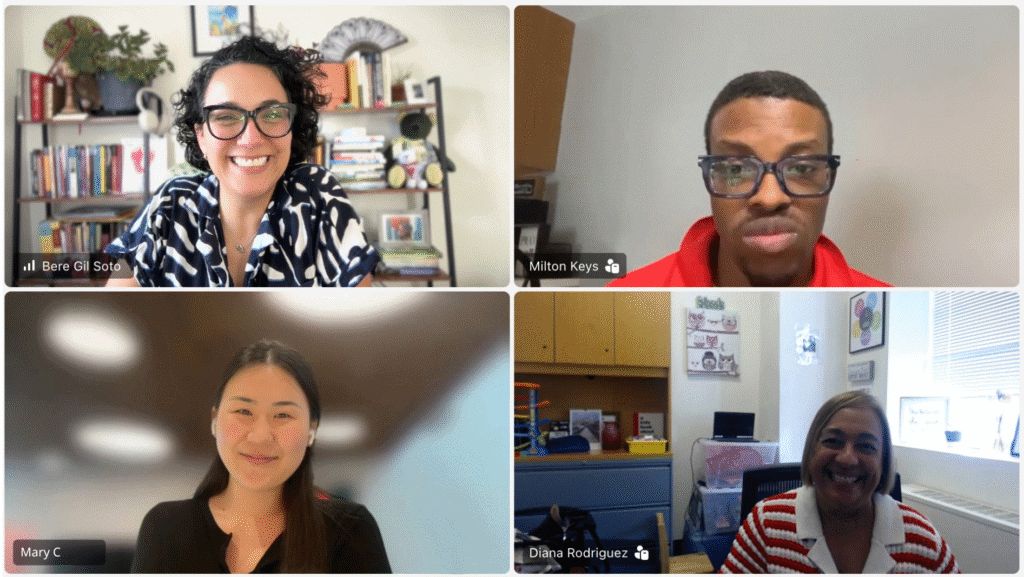
To help ground the team’s work in real stories and real needs, Rev. Gil Soto interviewed team members about what moved them to join the R&D team, what they’ve seen in the church, and what they hope can be built together. “We’re not designing in the abstract,” Bere said. “We’re listening first, because true inclusion starts with attention.”
What moved you to say yes to being part of this Research & Design Team?
Diana Rodriguez (NBA Trustee, experienced licensed clinician specializing in disabilities): What moved me to say yes is a deep sense that church should be a place where everyone truly belongs—not just in theory, but in lived experience. I’ve seen how easily people with disabilities can be unintentionally excluded, not because of a lack of care, but because of a lack of awareness or design. That gap matters to me.
Mary C. (NBA API Young Adult Peer Group member, Speech and Language Pathology Graduate Student, and disabilities advocate): I said yes because this work connects really closely to what I care about professionally, academically, and personally. As a future speech-language pathologist, I’m interested in access to communication and making sure people are able to participate and be heard in their communities. I am grateful to be a part of something that could create opportunities for other young adults, especially YA with Disabilities, where they feel belonging, growth, and contribute to their community.
Rev. Dr. Milton Keys (Person living with disabilities, NBA imPACT Fellow, Executive Director of Advocates Embassy): As a man with a disability, I’m very familiar with the obstacles that people with disabilities face in society. So I was excited to be a part of a team that was researching ways that we can support this population. My ministry is focused on helping the church welcome people with disabilities. This team gives me the opportunity to do that work on a larger scale by providing a place for people with disabilities to be supported.
Our team uses the following definition of disability:
“Disability arises when a person’s participation is impaired by physical, social, technological, or attitudinal environments that are not designed to support the full range of human diversity. These barriers often require individuals to seek additional assistance to navigate the world. Disability is not located solely within an individual, but in how society accommodates, or fails to accommodate diversity.”
This definition focuses on barriers in environments, not deficits in people. How does this perspective change the kinds of questions we ask and programs we imagine?
Diana: Shifting the focus from deficits in people to barriers in environments changes everything. It leads us to design programs that are flexible, inclusive from the start, and responsive to a wider range of need, rather than reactive or one-size-fits-all. It also encourages us to listen more closely to people’s lived experiences, because they can best identify where those barriers exist. Ultimately, it helps us imagine a church where accessibility isn’t an add-on, but a core value woven into everything we do.
Mary: Shifting from a deficit-based view to understanding Disability as something shaped by environmental and systemic barriers really changes how we approach this research/collecting data phase. It allows us to ask more open-ended and experience-based questions, allowing the participants to share what has been helpful for them, what has not, and what true inclusion and belonging looked and felt like. We aim to create spaces that are accessible, welcoming, and flexible.
Milton: I think it changes the way we perceive our target audience. Instead of looking at this population as a group of people that need to be helped or fixed, we looked at a population that society was limiting. That allowed us to ask questions that really seek to discover the ways in which we can be a help to others so that they can overcome these artificial barriers. This empowers them to tell their stories in a way that they know that they will be honored, and empowers us to design programming that really helps meet their needs. When we realize they have potential and they just need help with the obstacles, we can hone into their needs, their wants, and their desires to provide services that are not only effective but also Christ-like.
From your work alongside individuals and families impacted by disability, what gaps do you see in how faith communities support people?
Diana: One of the biggest gaps I see is the difference between welcome and belonging. Many faith communities are warm and well-intentioned, but still operate in ways that unintentionally exclude—whether through physical spaces, program structures, communication styles, or assumptions about participation.
Another gap is consistency. Families can feel like they have to advocate repeatedly or carry the burden of making things work, which can be exhausting and isolating. There’s also sometimes a lack of listening—programs are created for people with disabilities without being shaped with them.
I also notice that disability is often approached as a specialized “ministry area” instead of being seen as something that touches every part of church life—worship, community, leadership, and spiritual formation. That can unintentionally limit opportunities for people with disabilities to fully participate and contribute their gifts.
As a young adult studying and advocating in the disability field, what excites you most about this research, and what feels especially important to get right?
Mary: What excites me most is the opportunity to listen and learn from people’s real experiences, and to use that info to shape something meaningful. I see a great opportunity to represent our church community more accurately and inclusively, instead of relying on assumptions or gaps in data. What feels especially important to get right is how we listen and represent the experiences that are shared with us. I want to make sure we honor and respect their experiences!
How have your own experiences living with a disability shaped how you see the church, and what do you hope the church might better understand through this work?
Milton: I think living in a society that often puts obstacles in my way and then going to a church that doesn’t always understand those obstacles and sometimes adds to those obstacles makes me look at the church differently. More importantly I think church has seen me differently. Some have seen me as some extraordinary person because I have a disability, some have seen me as a burden, some have seen me as someone that needs fixing. I think we need to strive for a church that sees disability as a normal part of the human experience.
How do you hope this work will help our church today?
Diana: My hope for this work is that it helps move our church toward a more integrated and intentional approach—where accessibility and inclusion are part of the foundation, not an afterthought. I hope we create systems and environments that reduce the need for constant advocacy, and instead communicate clearly: “You belong here.”
More than anything, I hope this work helps us listen better, design with people instead of for them, and build a community where individuals and families impacted by disability are not just supported, but known, valued, and able to fully participate in the life of the church.